Breaking the Stigma That Keeps Physicians From Seeking a Rehab Center for Doctors in Salt Lake City

Physicians spend their careers caring for others. They diagnose illnesses, manage crises, and make life-or-death decisions, frequently with insufficient sleep and under too much pressure. As a result, when addiction or mental health issues emerge discreetly, many doctors are caught between knowing they need treatment and being afraid of what will happen if they seek it.
This fear has a name: stigma. And it is one of the most significant impediments to physicians receiving the care they deserve. Finding a credible rehab center for doctors in Salt Lake City like Sovegna, might be difficult for Utah doctors, not because the options do not exist, but because the culture of medicine makes reaching out feel risky.
Why Doctors Fight in Silence
From the first day of medical school, students are taught to be self-reliant. Students of medicine are taught to push past exhaustion. Residents learn the unspoken rule: vulnerability is weakness. Asking for help after years of practice can seem like an admission that you have failed.
This is not paranoia. When substance abuse or psychiatric disorders are discovered, physicians face serious professional consequences. Mental health is a factor in decisions made by state medical boards, hospital accreditation committees, malpractice insurance companies, and even state medical boards. Even though the systems are intended to promote recovery, many doctors do not make the decision because they fear punishment.
It is not surprising that addiction rates in the medical profession are higher than those of the general public, while treatment rates are far lower. The clinical reality of addiction is known by doctors better than anyone else, but they still believe they can handle it on their own.
The Cost of Staying Silent
When physicians avoid treatment, the consequences ripple outward. Untreated addiction affects judgment, motor skills, emotional regulation, and decision-making, all of which are critical in clinical practice. Relationships deteriorate. Physical health declines. The very career a physician is trying to protect becomes the thing most at risk.
There is also an internal cost that rarely gets talked about. Many physicians struggling with addiction carry deep shame, a sense that they should have known better or been stronger. That shame compounds over time, feeding isolation and making it even harder to reach out. It becomes a cycle: the worse things get, the more impossible help feels.
What many physicians don't realize is that early intervention dramatically improves outcomes, both for personal recovery and for career preservation. The longer the treatment is delayed, the more difficult the road becomes.
What Makes Treatment for Physicians Different
Physicians are not the same as the general population when it comes to addiction treatment, and their care shouldn't look the same either. Doctors bring a unique set of challenges to recovery: high-functioning patterns that mask the severity of the problem, deep medical knowledge that can be used to rationalize or self-treat, professional obligations that make stepping away from work feel impossible, and a peer group that may enable denial.
At Sovegna, we understand this deeply. Our Recovery for Professionals program was built specifically for high-achieving individuals, including doctors, attorneys, executives, and other professionals, who need expert care without sacrificing discretion or career continuity. As a rehab center for doctors in Salt Lake City, we know that surface-level interventions won't hold up under the kind of pressure physicians face every day.
That is why we take an integrated, multidisciplinary approach that addresses the whole person, not just the substance use. Our programming combines evidence-based addiction medicine, integrative psychiatry, skilled therapy, restorative nutrition, and meditative movement, all rooted in the mindfulness philosophy that defines everything we do at Sovegna.
Outpatient Recovery That Respects a Physician's Life
One of the most common misconceptions regarding addiction treatment is that you have to step away from everything. Many physicians are afraid to seek help because they think a residential program lasting 30 or 60 days is too long. Many doctors are unable to leave their patients, practice, or families for such a long time.
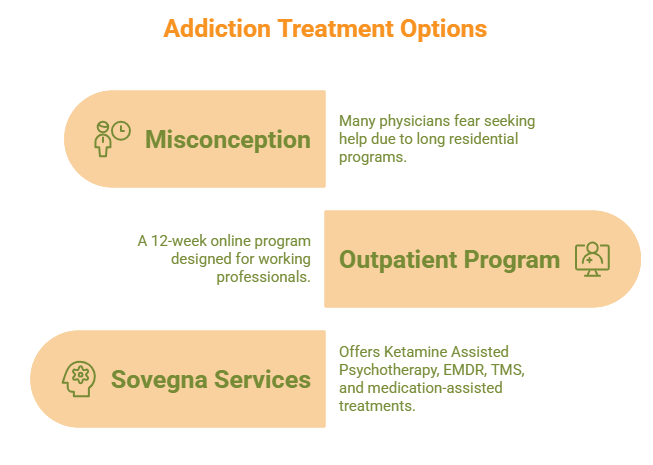
The 12-week outpatient treatment program is another option. The program was designed by Susie Wiet, MD, our founder,r who is board-certified both in psychiatry as well as addiction medicine. It includes group therapy, psychoeducation, and weekly Q&A with Dr. Wiet. All of this can be done online. It is clinically advanced, rigorous, and designed around the realities of working professionals' lives.
Sovegna offers a full range of services to physicians, including Ketamine Assisted Psychotherapy, EMDR, and Transcranial Magnetic Stimulation. We also offer medication-assisted treatments. We are a rehab center for doctors in Salt Lake City that treats professionals. This means we make sure all elements of treatment work together to promote sustained and long-term recovery.
Redefining Strength as a Physician
The culture of medicine is slowly changing. More physicians are publicly discussing burnout, mental health, and addiction. More state medical boards are adopting wellness-oriented programs that prioritize therapy over punishment. More doctors are recognizing that getting help is not a show of weakness, but rather one of the most courageous actions a physician can take.
Recovery does not indicate the end of a career. In many circumstances, it represents the start of a more grounded, sustainable, and meaningful life. Physicians who participate in therapy frequently discover that the abilities they develop in recovery, such as self-awareness, emotional regulation, and mindfulness, make them better therapists, not worse ones.
If you are a physician dealing with addiction, trauma, or mental health issues, you are not alone. At Sovegna, we have built a safe, discreet, and clinically outstanding environment in which professionals can heal fearlessly. Reaching out is not detrimental to your career. It may be the most crucial thing you do to safeguard it.